
The Second Anointing: Liturgy, Deification, and the Transcendent Logic of Ceremonial Religion

The Mormon second anointing is best understood not as an eccentric appendix to nineteenth-century Mormon temple ritual, but as a highly concentrated rite of exaltation that stands at the intersection of liturgy, theology, myth, secrecy, and sacred anthropology. David John Buerger, whose 1983 Dialogue essay remains the foundational study, described the rite as “the capstone of the endowment,” and linked it directly to the reception of the “fulness of the priesthood.”[1] Historically, the ordinance emerged in Nauvoo in September 1843, within Joseph Smith’s final cycle of temple innovation, alongside the endowment, celestial marriage, the fuller theology of sealing, and the increasingly explicit claim that human beings may become divine.[2] In comparative perspective, the ordinance can be read as Mormonism’s most compact expression of a recurrent pattern in Western esoteric religion: purification, investiture, sacred pairing, ratification by authorized mediators, and eventual participation in divine life.[3]
This essay argues that the second anointing belongs within the broader field of Western esotericism not because it is reducible to magic, Hermeticism, or occultism, but because it shares with those currents a common ritual grammar of ascent, mediation, transformation, and hidden transmission. John L. Brooke’s influential but contested The Refiner’s Fire argued that early Mormon cosmology developed within a world already saturated with Hermetic, alchemical, Christian-theosophical, and Masonic ideas about divine ascent and sacred union.[4] Even scholars who reject Brooke’s stronger genealogical claims generally concede that Mormonism’s temple system is unusually compatible with the categories used in the academic study of esotericism: secrecy, hierarchy, cosmological ascent, ritual mediation, and the aspiration to deification.[5] The second anointing is therefore best approached as a form of liturgical theurgy: a rite whose purpose is not merely symbolic remembrance, but ontological elevation and eschatological sealing.[6]
Western Esotericism and Ritual Mediation
Modern scholarship on Western esotericism has repeatedly emphasized several recurrent characteristics: correspondences between levels of reality, mediation through symbols and rites, the transformative potential of religious imagination, and the transmission of hidden wisdom through initiatory structures.[7] Antoine Faivre’s influential model identifies “correspondences,” “living nature,” “imagination and mediations,” and “the experience of transmutation” as central features of the esoteric form of thought.[8] Although Faivre’s typology has been refined and criticized, it remains useful because it captures a pattern visible across Hermeticism, Christian Kabbalah, alchemy, ceremonial magic, Rosicrucianism, and initiatic Freemasonry.[9] In these traditions, ritual does not merely commemorate. It mediates between the visible and invisible orders and presumes that the human being can be altered through contact with higher realities.[10]
The second anointing belongs in this field because it exhibits the same formal properties. It is restricted, initiatory, hierarchical, and tied to a specific line of authority; it presupposes that ritual action administered by authorized mediators can change a participant’s standing before heaven; and it culminates in transformed status described in royal-priestly and exalted terms.[11] Buerger’s account shows that from its inception the rite was associated with being “sealed up unto eternal life” and with the language of “calling and election made sure.”[12] Even where Mormonism rejects the label “occult,” its temple system remains structurally esoteric in the academic sense: hidden, graded, symbolically dense, and directed toward a higher anthropology than ordinary Protestant Christianity allows.[13]
Nauvoo, Priesthood Fullness, and the Logic of Exaltation
The standard historical treatment remains Buerger’s “The Fulness of the Priesthood,” which states that “this special priesthood ordinance was first administered on 28 September 1843 to Joseph and Emma Smith.”[14] He further notes that in the months that followed, “fulness of priesthood blessings during Joseph Smith’s lifetime were reserved primarily for Church leaders,” making the ordinance from the beginning a privilege of the inner leadership core rather than a routine temple rite.[15] Church materials on the Anointed Quorum confirm that Joseph first introduced the temple endowment to a select body of trusted associates in May 1842 and continued to transmit advanced temple forms through this inner group.[16] The second anointing was therefore not simply another ceremonial layer. It functioned as the culminating moment of an internal liturgical ascent.
This historical setting is inseparable from Joseph Smith’s final doctrinal developments. In the King Follett Discourse, Smith declared, “God himself was once as we are now, and is an exalted man,” and then pressed the point further: “You have got to learn how to be gods yourselves.”[17] The official church history treatment of the discourse similarly observes that Joseph taught the coeternity of intelligences with God and the possibility that humans might advance into divine likeness.[18] The second anointing performs the liturgical consequence of that anthropology. The sermon announces that divinity is the human destiny; the ordinance ritually seals selected recipients into that destiny as kings, priests, queens, and priestesses before God.[19]
Liturgy as Theurgy
The category of theurgy is useful because it names ritual action aimed at union with, or elevation toward, the divine through consecrated forms. In late antique Platonizing and later ceremonial traditions, theurgy presumes that sacred acts possess effective force because they participate in higher realities and are not reducible to human intention.[20] Although Mormon theology would reject the label “magic,” the second anointing closely resembles theurgical logic in this more technical sense. It is a ritual of mediated elevation in which authorized action is believed to alter the participant’s ontological and eschatological standing.[21]
This comparison clarifies why the second anointing is best understood as liturgical rather than magical in its own self-description, yet theurgical in its deeper structure. The ordinance is not offered as the manipulation of occult forces, but as a sealing act through priesthood authority. Yet, like theurgy, it depends on a chain of transmission, a consecrated setting, and a conviction that ritual can elevate the participant into a more divine order of existence.[22] Ceremonial magic often seeks knowledge of the Holy Guardian Angel, operative access to angelic or cosmic powers, or the reintegration of the self with a higher principle.[23] The second anointing seeks something at once more ecclesial and more audacious: the authoritative promise of celestial enthronement within a priestly and familial order.[24]
Sacred Pairing, Bridal Chamber, and Hieros Gamos
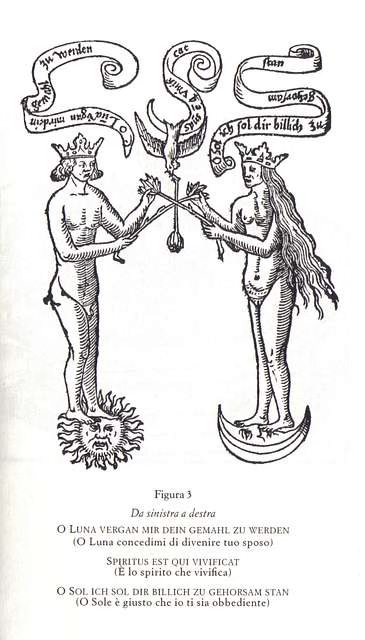
One of the second anointing’s most important features is that it is administered to a married couple, not merely to isolated individuals. A Sunstone discussion of temple queens and priestesses summarized the first portion of the rite as “an anointing administered by the head of the high priesthood, who anoints the man to be a king and priest to God and the woman to be a queen and priestess.”[25] The marital structure places the ordinance in close comparative proximity to the great esoteric motif of the sacred marriage. In alchemy, the coniunctio is figured as the union of king and queen, sun and moon, sulfur and mercury, whose conjunction resolves division and yields a higher wholeness.[26] In the Gnostic and especially Valentinian traditions, the bridal chamber functions as the supreme sacramental image of restored fullness, in which Christ and Sophia, or the soul and its heavenly counterpart, are reunited in the healing of primordial division.[27]
The Gospel of Philip gives the classic articulation of this symbolism: “The mysteries of truth are revealed in symbols and images. The bridal chamber, however, remains hidden.”[28] Elsewhere the text states, “If the woman had not separated from the man, she would not die with the man. His separation became the beginning of death. Because of this Christ came, to repair the separation which was from the beginning, and again to unite the two.”[29] These lines are central to modern scholarly readings of the Valentinian bridal chamber because they link salvation to restored union rather than to pardon alone.[30] Mormon exaltation is not imagined as solitary apotheosis but as the glorification of an eternal pair sealed together, enthroned together, and destined for divine increase.[31] The comparison is therefore not a claim of borrowing, but of shared mythic architecture.
Gnostic Syzygy and Jungian Psychology
The comparison deepens through the concept of syzygy. In Valentinian cosmology, a syzygy is a male-female pair of aeons whose complementarity expresses the structure of the Pleroma itself.[32] Modern summaries of Valentinianism note that, just as Sophia is united with the Savior, “the faithful would experience a union with their angel in the Pleroma,” and that the bridal chamber ritual was performed “after the pattern of the higher Syzygia.”[33] In such a framework, salvation is not only forgiveness but restoration to fullness through reunion with a heavenly counterpart.[34]
Jung appropriated this symbolic pattern into depth psychology by treating syzygy as an archetypal pairing of contrasexual opposites. A Jungian glossary based directly on Aion describes syzygy as “an archetypal pairing of contrasexual opposites, which symbolized the communication of the conscious and unconscious minds, the conjunction of two organisms without the loss of identity.”[35] Jung’s interest in Gnosticism lay precisely here: its myths of split and reunion dramatized the movement toward psychic totality. From a Jungian perspective, the second anointing can therefore be read as a symbolic dramatization of elevated polarity resolved into a more comprehensive wholeness. Such a reading does not replace the ordinance’s theological meaning, but it helps explain why the rite’s marital and royal symbolism carries such depth. It presents exaltation not simply as reward, but as ordered completion.[36]
Enoch, Metatron, and the Traversable Border of Divinity
Another important comparative strand is the Enochic tradition. In 2 Enoch, Enoch describes his transformation in language that has rightly attracted comparison with later theosis traditions: “And the Lord said to Michael, ‘Go and extract Enoch from his earthly clothing. And anoint him with my delightful oil, and put him into the clothes of my glory.’”[37] In 3 Enoch and Merkabah materials, that movement culminates in the figure of Metatron, enthroned near the divine throne and invested with extraordinary authority. Scholars such as Andrei Orlov have shown that this Enoch–Metatron trajectory constitutes one of the clearest Jewish examples of human elevation into quasi-divine status.[38]
The family resemblance to Mormon exaltation is unmistakable. In both cases, the righteous human is not merely forgiven but glorified, enthroned, named, and brought into the divine council.[39] The difference is equally important. Metatron’s exaltation is visionary, singular, and cosmically concentrated; Mormon exaltation is covenantal, liturgical, and, in principle, extendable to many faithful couples through ordinances.[40] What Enochic mysticism narrates in apocalyptic myth, Mormonism ritualizes in temple form.
Later Jewish, Christian, Hermetic, and Islamicate traditions deepen the comparison by identifying Enoch with Hermes/Thoth and by weaving him into stories of antediluvian wisdom preserved on pillars in the “Seriadic” land, often identified with Egypt.[41] These traditions do not prove a historical transmission from Egyptian rites to Mormon liturgy. They do, however, show how the Western esoteric imagination repeatedly fuses ascent, sacred writing, primordial wisdom, and temple-like transmission into a single mythic complex.[42]
Egypt, Temple Investiture, and Sacred Ratification
Ancient Egyptian religion provides another revealing comparative field. Egyptian temple and funerary systems repeatedly stage washing, vesting, restricted access, divine legitimation, and transformation into a blessed or empowered state.[43]Initiation materials associated with Karnak describe a higher priestly induction in which the initiate is washed, vested with insignia, and brought before the hidden image of Amun.[44] These rites are not equivalent to the Mormon second anointing, but they share the same movement from ritual preparation to elevated status and divine proximity.[45]
The Demotic narrative known as “The Battle for the Prebend of Amun” is especially suggestive. The text concerns a contested prebend, that is, a temple office with associated privileges and revenues, within the cult of Amun.[46] Modern scholarship on the tale treats it as a Demotic novella about temple office and sacred privilege rather than as a theological treatise or a direct ancestor of later traditions.[47] There is therefore no scholarly basis for treating the text as a precursor to Mormon sealing or the second anointing. Even so, it displays a logic of sacred ratification in which divine favor and authorized institutional mediation combine to secure a durable privileged status.[48] Mormonism radicalizes this pattern by relocating it from hereditary temple office and cultic economy into eternal family, priesthood fullness, and exaltation.[49]
Ceremonial Magic and the Transcendent Corpus
If one turns from ancient and medieval comparanda to modern ceremonial magic, the parallels become more formal than doctrinal. The Great Work in modern occultism often aims at illumination, union with the Holy Guardian Angel, reintegration of the fragmented self, or ascent through graded initiation toward divine realization.[50] Aleister Crowley, for example, described the central task of the adept as the attainment of “the Knowledge and Conversation of the Holy Guardian Angel.”[51] Golden Dawn and Thelemic practice preserve a strongly liturgical approach to transcendence: temple space, vestments, consecrated signs, ritual speech, and graded mysteries mediate a real relation between practitioner and supernal order.[52]
The second anointing is analogous to these transcendent corpuses in one crucial respect. It represents the culminating rite of an initiatory path in which lower stages prepare for a more interior consummation.[53] Yet it differs from most magical systems in that the culmination is juridical and ecclesial rather than exploratory or visionary. It does not promise increasing operative knowledge of hidden forces. It promises that a couple’s celestial destiny has been ritually and authoritatively sealed.[54] In this respect, Mormonism stands closer to sacramental theurgy than to experimental occultism. Its temple system is a ceremonial religion in which transcendence is mediated through covenantal liturgy rather than magical technique.
Meaning Within the Western Esoteric Tradition
What, then, is the second anointing within the broader Western esoteric tradition? It is not a disguised Masonic degree, not a Hermetic survival in simple Christian dress, and not a detachable curiosity within Mormon history.[55] It is a distinctly Mormon rite that nonetheless belongs to the same enduring family of practices that seek to mediate divine ascent through hidden ritual forms. Its logic is recognizably esoteric because it joins secrecy, initiation, sacred pairing, hierarchical transmission, transformed status, and participation in a higher ontological order.[56]
That conclusion matters for both Mormon studies and the study of esotericism. For Mormon studies, it clarifies that the second anointing cannot be understood apart from the broader doctrines of exaltation, sealing, and priesthood fullness announced in Nauvoo and crystallized in the King Follett Discourse.[57] For esotericism, it demonstrates that a modern American restorationist movement developed one of the most elaborate ritualized theologies of deification in the post-Reformation West, and did so by converting the grammar of mystery, mediation, and divine ascent into a temple-centered Christian liturgical system.[58]
The second anointing is therefore best described as Mormonism’s most concentrated sacrament of exaltation.[59] In historical terms, it emerged as the inner culmination of Joseph Smith’s Nauvoo temple project.[60] In theological terms, it performs the consequences of a doctrine of divine humanity and human divinization articulated most famously in the King Follett Discourse.[61] In comparative terms, it resonates with Gnostic bridal symbolism, alchemical sacred union, Enochic enthronement, Egyptian sacred ratification, and the graded transcendence of ceremonial religion, while remaining irreducibly Mormon in its covenantal, familial, and priesthood-centered form.[62] The strongest interpretation is therefore neither genealogical reduction nor apologetic exceptionalism. The second anointing is better understood as a modern Christian rite that participates in an older esoteric grammar of theosis: washing, anointing, naming, pairing, enthroning, sealing, and promising participation in divine life.[63]
1. David John Buerger, “‘The Fulness of the Priesthood’: The Second Anointing in Latter-day Saint Theology and Practice,” Dialogue: A Journal of Mormon Thought 16, no. 1 (Spring 1983): 10–44.
2. Buerger, “‘The Fulness of the Priesthood,’” 10–18; “Anointed Quorum (‘Holy Order’),” Church History Topics, The Church of Jesus Christ of Latter-day Saints, accessed May 12, 2026, https://www.churchofjesuschrist.org/study/history/topics/anointed-quorum?lang=eng;“Temple Endowment,” Church History Topics, The Church of Jesus Christ of Latter-day Saints, accessed May 12, 2026, https://www.churchofjesuschrist.org/study/history/topics/temple-endowment?lang=eng.
3. John L. Brooke, The Refiner’s Fire: The Making of Mormon Cosmology, 1644–1844 (Cambridge: Cambridge University Press, 1994), 283–315; Andrei A. Orlov, The Enoch-Metatron Tradition (Tübingen: Mohr Siebeck, 2005), 1–12; Antoine Faivre, “Introduction I,” in Modern Esoteric Spirituality, ed. Antoine Faivre and Jacob Needleman (New York: Crossroad, 1992), xv–xxii.
4. Brooke, The Refiner’s Fire, xiii–xvii, 283–315.
5. “Esoteric Mormonism: Marginal or Mainstream?” Times and Seasons, April 2012, archived discussion of the Brooke thesis and later scholarship, accessed May 12, 2026, https://archive.timesandseasons.org/2012/04/esoteric-mormonism-marginal-or-mainstream/index.html; Kocku von Stuckrad, “Esotericism Made Exoteric? Public Debates and the Study of Religion,” Scripta Instituti Donneriani Aboensis 26 (2015): available via Journal.fi.
6. Buerger, “‘The Fulness of the Priesthood,’” 14–18.
7. Wouter J. Hanegraaff, Western Esotericism: A Guide for the Perplexed (London: Bloomsbury, 2013), 1–19; Faivre, “Introduction I,” xv–xxii.
8. Antoine Faivre, Access to Western Esotericism (Albany: SUNY Press, 1994), 10–15.
9. Hanegraaff, Western Esotericism, 1–19; Faivre, Access to Western Esotericism, 10–15.
10. Hanegraaff, Western Esotericism, 11–17.
11. Buerger, “‘The Fulness of the Priesthood,’” 14–21.
12. Ibid., 16–18.
13. Von Stuckrad, “Esotericism Made Exoteric?”; “Esoteric Mormonism: Marginal or Mainstream?”
14. Buerger, “‘The Fulness of the Priesthood,’” 18.
15. Ibid., 18–21.
16. “Anointed Quorum (‘Holy Order’).”
17. Joseph Smith, “Discourse, 7 April 1844, as Reported by Wilford Woodruff,” in The Joseph Smith Papers, accessed May 12, 2026,
https://www.josephsmithpapers.org
; see also “The King Follett Sermon,” Church History Topics, The Church of Jesus Christ of Latter-day Saints, accessed May 12, 2026, https://www.churchofjesuschrist.org/study/history/topics/king-follett-sermon?lang=eng.
18. “The King Follett Sermon,” Church History Topics.
19. Buerger, “‘The Fulness of the Priesthood,’” 16–20.
20. Gregory Shaw, Theurgy and the Soul: The Neoplatonism of Iamblichus (University Park: Pennsylvania State University Press, 1995), 3–12.
21. Buerger, “‘The Fulness of the Priesthood,’” 14–20.
22. Ibid.; “Anointed Quorum (‘Holy Order’).”
23. Aleister Crowley, Magick in Theory and Practice (Paris: Lecram Press, 1929), chap. 21; see also secondary summaries in modern ceremonial magic scholarship.
24. Buerger, “‘The Fulness of the Priesthood,’” 16–20.
25. Margaret Toscano, “The Missing Rib: The Forgotten Place of Queens and Priestesses in the Establishment of Zion,” Sunstone 51 (1985): 16–22.
26. C. G. Jung, Mysterium Coniunctionis, trans. R. F. C. Hull, 2nd ed., Collected Works of C. G. Jung, vol. 14 (Princeton, NJ: Princeton University Press, 1970), 3–25.
27. Einar Thomassen, The Spiritual Seed: The Church of the ‘Valentinians’ (Leiden: Brill, 2006), 361–391; Elaine Pagels, The Gnostic Gospels(New York: Random House, 1979), 143–150.
28. Wesley W. Isenberg, trans., “The Gospel of Philip,” in The Nag Hammadi Library in English, ed. James M. Robinson, 3rd rev. ed. (San Francisco: HarperSanFrancisco, 1990), 145.
29. Isenberg, “The Gospel of Philip,” 150.
30. Thomassen, The Spiritual Seed, 361–391; Pagels, The Gnostic Gospels, 143–150.
31. Buerger, “‘The Fulness of the Priesthood,’” 16–20; Brooke, The Refiner’s Fire, 283–315.
32. Kurt Rudolph, Gnosis: The Nature and History of Gnosticism, trans. Robert McLachlan Wilson (San Francisco: Harper & Row, 1987), 314–321.
33. “Valentinianism,” in Encyclopaedia Britannica, accessed May 12, 2026, https://www.britannica.com/topic/Valentinianism.
34. Thomassen, The Spiritual Seed, 361–391.
35. Daryl Sharp, Jung Lexicon: A Primer of Terms & Concepts (Toronto: Inner City Books, 1991), s.v. “syzygy”; see also C. G. Jung, Aion, trans. R. F. C. Hull, Collected Works of C. G. Jung, vol. 9, pt. 2 (Princeton, NJ: Princeton University Press, 1959), 14–16.
36. Jung, Mysterium Coniunctionis, 3–25; Jung, Aion, 14–16.
37. F. I. Andersen, “2 (Slavonic Apocalypse of) Enoch,” in The Old Testament Pseudepigrapha, ed. James H. Charlesworth, vol. 1 (Garden City, NY: Doubleday, 1983), 139.
38. Orlov, The Enoch-Metatron Tradition, 1–12, 221–280.
39. Ibid., 221–280; Buerger, “‘The Fulness of the Priesthood,’” 16–20.
40. Orlov, The Enoch-Metatron Tradition, 221–280; Buerger, “‘The Fulness of the Priesthood,’” 18–21.
41. Jason Colavito, “How Did Enoch Come to Be Identified with Hermes Trismegistus?” JasonColavito.com, July 13, 2018, summarizing relevant late antique and medieval sources; Flavius Josephus, Antiquities of the Jews 1.2.3.
42. Josephus, Antiquities 1.2.3; Colavito, “How Did Enoch Come to Be Identified with Hermes Trismegistus?”
43. Jan Assmann, Death and Salvation in Ancient Egypt, trans. David Lorton (Ithaca, NY: Cornell University Press, 2005), 227–262.
44. Hugh Nibley, “The Early Christian Prayer Circle,” BYU Studies 19, no. 1 (1978): 41–78; for the Karnak comparison see also the translated initiation material commonly cited in temple-comparative literature.
45. Assmann, Death and Salvation in Ancient Egypt, 227–262.
46. “The Battle for the Prebend of Amun,” trans. at Attalus.org, based on Papyrus Spiegelberg, accessed May 12, 2026, https://www.attalus.org/egypt/prebend.html.
47. Mirjam Cross, “Mouvance and the Art of Fiction in Performance in Manuscripts of the Demotic Novella ‘The Prebend of Amun,’” conference abstract indexed by Semantic Scholar; “Narrative Compositions in Demotic and Biblical Literature,” Humboldt University project description, accessed May 12, 2026.
48. “The Battle for the Prebend of Amun”; “Narrative Compositions in Demotic and Biblical Literature.”
49. Buerger, “‘The Fulness of the Priesthood,’” 16–20; Joseph Smith, “Discourse, 7 April 1844.”
50. Crowley, Magick in Theory and Practice, chap. 21; Wouter J. Hanegraaff, ed., Dictionary of Gnosis and Western Esotericism (Leiden: Brill, 2005), entries on “Ceremonial Magic,” “Golden Dawn,” and “Thelema.”
51. Crowley, Magick in Theory and Practice, chap. 21.
52. Hanegraaff, ed., Dictionary of Gnosis and Western Esotericism, s.v. “Ceremonial Magic,” “Golden Dawn,” and “Thelema.”
53. Buerger, “‘The Fulness of the Priesthood,’” 14–20.
54. Ibid., 16–20.
55. Brooke, The Refiner’s Fire, 283–315; reassessments summarized in “Esoteric Mormonism: Marginal or Mainstream?”
56. Faivre, Access to Western Esotericism, 10–15; Buerger, “‘The Fulness of the Priesthood,’” 14–21.
57. Joseph Smith, “Discourse, 7 April 1844”; Buerger, “‘The Fulness of the Priesthood,’” 16–20.
58. Brooke, The Refiner’s Fire, 283–315; Hanegraaff, Western Esotericism, 1–19.
59. Buerger, “‘The Fulness of the Priesthood,’” 10–20.
60. Ibid., 18–21; “Anointed Quorum (‘Holy Order’).”
61. Joseph Smith, “Discourse, 7 April 1844”; “The King Follett Sermon.”
62. Thomassen, The Spiritual Seed, 361–391; Jung, Mysterium Coniunctionis, 3–25; Orlov, The Enoch-Metatron Tradition, 221–280; Assmann, Death and Salvation in Ancient Egypt, 227–262.
63. Faivre, Access to Western Esotericism, 10–15; Buerger, “‘The Fulness of the Priesthood,’” 14–21.